


1. Proposal Description
Unauthorized UAV intrusions create new-emerging security risks for critical public-sector facilities. Illegal drones are capable of threatening energy infrastructure, port facilities and other key public assets. Their high-speed maneuverability and low-altitude flight profiles bring practical challenges to conventional airspace monitoring systems.
Meanwhile, existing detection solutions perform poorly against low-altitude, low-speed and small-size targets. Ground clutter and interference sources such as birds often lead to high false-alarm rates. RF detection relies on signal emission from targets and may fail against pre-programmed autonomous flight. When facing frequency-hopping communication links, countermeasure equipment requires real-time signal analysis and dynamic parameter adjustment, while many existing systems still depend on preset modes and manual triggering.
To solve these challenges, our company presents this integrated counter-UAS system. It is specially optimized for high-speed maneuvering UAVs with low radar cross-section and frequency-hopping links. The solution fills monitoring gaps for key-site medium-and-low altitude airspace and mitigates risks from large-scale multi-UAV unauthorized intrusions.
2. System Advantage
The system adopts multi-source detection and layered countermeasure technologies. It combines low-altitude radar monitoring, RF reconnaissance and direction-finding with counter-measure hardware for gap-filling coverage of key sites and multi-intruder response. Portable reconnaissance, response and signal-deception devices support on-site mobile deployment.
The command-control platform fuses radar and RF detection data, automatically recommends response strategies and conducts unified equipment scheduling. Multi-device TDOA networking improves detection performance for low-observable targets. Functional modules can be tailored for different projects, and the whole system supports full operation auditing.
3. System Description
The complete system consists of low-altitude radar detection equipment, RF detection equipment, RF interference equipment and command & control platform.
Low-altitude radar equipment, RF detection equipment and UAV counter-measure devices constitute fixed-type and vehicle-mounted counter-UAS subsystems. They are designed for detection and signal counter-measures against high-speed maneuvering UAVs within medium-and-low altitude airspace, applicable for air-monitoring gap-filling at key sites and multi-intruder security response.
The command & control platform aggregates multi-source detection data to realize target correlation analysis, threat level assessment and unified scheduling of response resources. It supports standalone operation for single device as well as networked multi-device collaboration, improving regional air-situation awareness and overall security-response efficiency.
3.1 Low-Altitude Detection Radar
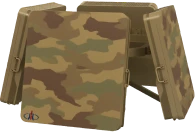
Table 1 Low-Altitude Detection Radar Specifications
|
Indicators |
Parameter |
|
Detection Architecture |
Two-Dimensional Phased Array, Pulse Doppler |
|
Frequency-band |
X-Band |
|
Range |
≥ 10 Km(RCS=0.01 ㎡) |
|
Detection Altitude |
1000m |
|
Minimum Target Speed |
≤ 2m/s |
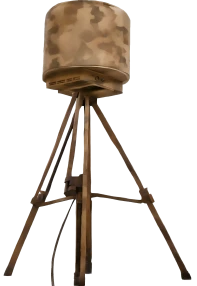
The Low-Altitude Detection Radar is designed following principles of low-cost, low-power consumption, reliable sealing performance and electromagnetic compatibility. It delivers stable detection and accurate measurement with advanced technical architecture. AI-enabled intelligent identification effectively suppresses false alarms.
Open system architecture features front-end and back-end decoupling and supports online firmware upgrade. This radar searches and tracks multiple low-altitude targets within the protected zone with 24/7 all-weather unattended operation. It classifies and identifies targets including drones and birds and maintains stable detection performance under heavy clutter environment. Vehicle-mounted mobile deployment is supported. Built-in functions cover system self-test, fault detection and fault location.
3.2 RF Detection Device
This unit integrates phase interferometer direction-finding, amplitude-correlation algorithm and Cognitive Radio Protocol Cracking (CRPC) technology. Combined with high-gain wide-coverage reconnaissance antennas and CRPC capability, it achieves UAV signal reconnaissance, direction-finding and model identification, outputting target data for early warning, surveillance and tracking within protected airspace.
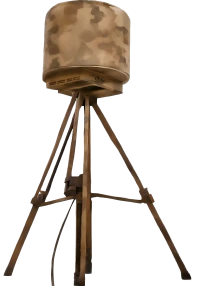
Table 2 RF Detection Device Specifications
|
Indicator |
Parameter |
|
Direction-Finding Frequency |
300MHz~8GHz |
|
Detection Range |
≥10km(EIRP≥26dBm) |
|
Accuracy |
≤3 °(RMS) |
|
Airspace coverage range |
Azimuth 0~360 °; Elevation 0~40 ° |
3.3 RF Interference Device
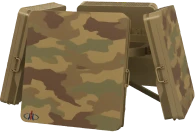
Multi-channel link-jamming technology is adopted. By transmitting customized jamming waveforms, UAV remote-control and video-transmission links can be suppressed. Spoofing satellite navigation signals received by drones enables response effects including expulsion, forced landing and virtual no-fly-zone enforcement, delivering effective protection within system coverage.
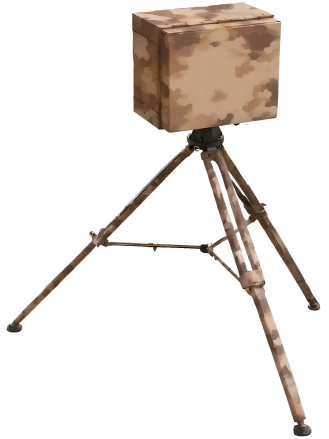
Table 3 RF Interference Device Specifications
|
Indicator |
Parameter |
|
Interference Frequency |
CH1: 300MHz~1.1GHz CH2: 800MHz~2.1GHz CH3: 1.8GHz~3.2GHz CH4: 2.9GHz~6GHz CH5: 5GHz~8GHz CH6: 1.1GHz~1.7GHz |
|
Navigation Interference Range |
≤5km |
|
Link Interference Range |
≤5km(Jamming-to-Communication range Ratio 10:1) |
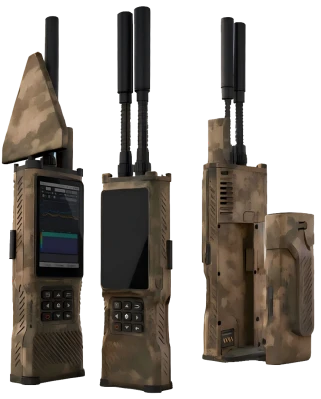
3.4 Portable Detection and Countermeasure Device
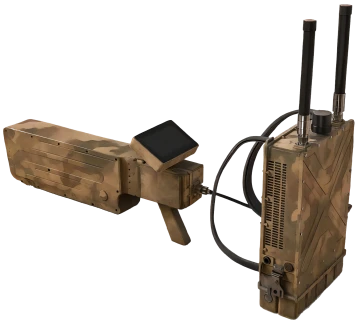
Table 4 Portable Detection and Countermeasure Device Specifications
|
Indicator |
Parameter |
|
Detection and Direction-Finding Frequency Band |
300MHz-6GHz |
|
Interference Band |
300MHz-6GHz |
|
Spoofing Frequency Band |
GPS L1C/A, GLONASS R1, BDS B1I, Galileo E1OS |
|
Detection Range |
≤3km |
|
Interference/Spoofing Range |
≤2km |
|
Protection Level |
IP65 |
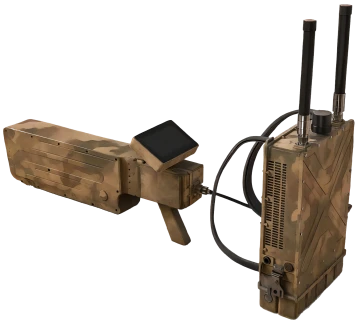
This integrated device combines reconnaissance, identification and counter-measure functions to deliver efficient detect-and-respond capability. Through RF spectrum scanning and real-time signal feature decoding, it captures remote-control and video-downlink signals from unauthorized UAVs. Electromagnetic-interference capability disrupts drone remote-control, video transmission and navigation signals. Navigation spoofing function supports active expulsion of intruding UAV targets.
3.5 Handheld Drone Detection Equipment
Through deep signal analysis and feature recognition, the handheld UAV detector can detect consumer-grade drones, FPV racing drones and typical industrial UAVs within effective range. It also identifies suspected signals from unknown UAV models, triggering timely vibration and audio alerts.
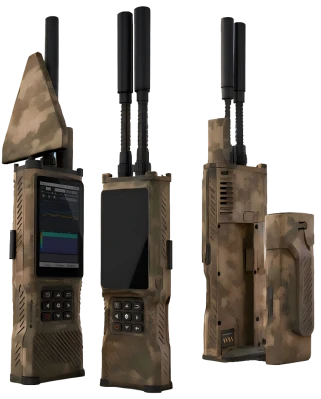
Table 5 Handheld Drone Detection Equipment Specifications
|
Indicator |
Parameter |
|
Working mode |
RF Detection and Signal Analysis |
|
Detection Frequency Band |
Supports 16 signal frequency bands within (70-6000MHz) |
|
Range |
1.5km |
|
Endurance |
≥6h |
3.6 Command and Control Platform
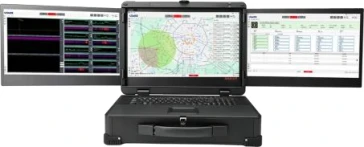
Visual operational map interface fuses and displays all target information on GIS map. Once UAV intruders are detected, early-warning will be activated automatically. Threat assessment is performed according to pre-configured electronic-fence rules and threat classification.
The platform supports one-click or auto-driven command dispatch of properly-positioned counter-measure units, and feeds back real-time response results on user interface. It integrates full-domain air-situation awareness, intelligent security-decision support and response-effect evaluation, built for intensive low-altitude security-protection scenarios.
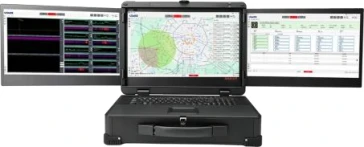
Table 6 Command and Control Platform Functions
|
Function |
Description |
|
Heterogeneous device interface |
Supports framework-based secondary development of device drivers, enabling simultaneous access, monitoring, and scheduling of own and third-party device resources, and supports heterogeneous networking of devices with different specifications and performance levels. |
|
Distributed deployment support |
Resources at all tiers support elastic scaling. Minimal deployment supports a single device, and geographically distributed deployment across data centers is supported. |
|
Fusion Algorithm |
Built-in multi-modal fusion algorithm, integrating AOA, TDOA, radar RID, 5G-A, Protocol parsing and other multi-modal data to improve perception accuracy and reduce false alarms. |
|
Visualization of airspace situation |
Based on GIS maps, dynamically display real-time situations such as the distribution, density, and flight status of unmanned aerial vehicles in the current airspace, supporting visualization presentations such as heat maps and trajectory overlays. At the same time, historical airspace data can be queried. |
|
Intelligent contingency plan |
Supports customizable early warning and countermeasure strategies. Countermeasure workflows are automatically generated through a rule engine, enabling unattended automated operation or manual execution of contingency plans. |
4. System Characteristics
(1) Integrated design of reconnaissance, interference, and spoofing.
(2) Reconnaissance and interference with full frequency coverage.
(3) 360° full airspace coverage.
(4) High reliability and great maintainability.
(5) Supports both fixed deployment and vehicle-mounted mobility, and features ease of operation.
5. Deployment Modes
The system supports fixed and mobile deployment under the same technical architecture. Configuration can be adjusted flexibly to satisfy diverse project requirements including long-term key-site guarding and temporary mobile security support. Users may choose fixed installation or vehicle-mounted mobile solution for fast setup of air-security capacity.
5.1 Fixed Deployment Mode
Fixed deployment applies to continuous long-term security-protection for key sites. Equipment can be mounted on towers, masts, building rooftops, wall brackets or ground foundations, ensuring unobstructed antenna sight-of-view for stable detection and counter-measure performance.
5.2 Mobile Deployment Mode
Mobile deployment fits scenarios including border public-safety patrol, temporary security-protection and major-event mobile support. After being integrated onto vehicle-borne platform, the system can operate upon arrival. Fast setup and withdrawal are achievable to meet timeliness requirements for mobile security missions.
5.3 Vehicle Modification Services
For mobile-deployment requirements, we provide vehicle-mounted adaptation services. Customer supplies vehicle chassis, and our team completes system-vehicle modification including:
Vehicle-mounted equipment bay / cabinet design
Antenna lifting & folding mechanism
Power-supply & power-generation system (vehicle power or independent generator unit)
Shock-absorption and electromagnetic compatibility treatment
In-vehicle operator console and cable integration
6. Custom Value
The counter-UAS system connects point-site protection with schedulable security assets. Fixed installations undertake continuous monitoring and primary-layer response for key locations; portable hardware delivers on-site mobile reinforcement.
The command & control platform aggregates multi-source detection data to generate unified air-situation picture. It automatically recommends and dispatches counter-measure resources, forming a closed-loop workflow: detection – assessment – response. Multi-device networking enables cooperative positioning and priority-driven resource allocation to avoid duplicated response actions. Incremental capacity expansion and compliance operation audit are supported.
7. Applicable Scenarios
7.1 Low-Altitude Gap-Filling Coverage for Critical Sites & Critical Infrastructure Protection
Fixed low-altitude security monitoring for important compounds, energy facilities and government complexes. The system covers low-and-medium altitude monitoring blind zones and forms layered complement with high-altitude air-monitoring systems.
7.2 Border Public-Safety & Major-Event Security
Modular assembly-disassembly capability supports border public-safety protection and major-event security projects. Multi-node networking realizes wide-range continuous protection; meanwhile fast deployment & withdrawal satisfy temporary emergency security needs.
7.3 Multi-Intruder UAV Event Response
Facing multiple simultaneous unauthorized-UAV incursion, command & control platform supports multi-target tracking and resource allocation. The system can process ≥20 radar tracks and ≥10 RF signals concurrently.
7.4 Vehicle-Mounted Mobile Security & Accompanying Low-Altitude Protection
The whole system can be integrated on vehicle-borne platform to deliver mobile low-altitude detection and signal-response capacity, providing dynamic air-space security protection for key mobile convoys and mobile-operation sites.
Disclaimer
This solution is displayed for project reference only. All related equipment shall be applied strictly in compliance with local laws & regulations for authorized public-safety applications. Export is subject to national export-control regulations. End-user verification is required for every project inquiry.
Backend Metadata (For Reference)
Product Title:Low-Altitude Defender - Integrated Low-Altitude Airspace Security Solution
URL Alias:low-altitude-defender-integrated-counter-uas-solution
Meta Description:
Low-Altitude Defender is an integrated low-altitude airspace security solution, combining radar detection, RF reconnaissance, signal countermeasure and command-control platform. Designed for critical-site protection, major-event security and border public-safety scenarios, supports fixed & vehicle-mounted flexible deployment. For project consultation only.
Keywords:Low-Altitude Airspace Security, Counter-UAS, Drone Detection, RF Reconnaissance, Site Protection, Vehicle-mounted Security System
Hot Tags: low-altitude airspace security systems, China, suppliers, factory, buy


